

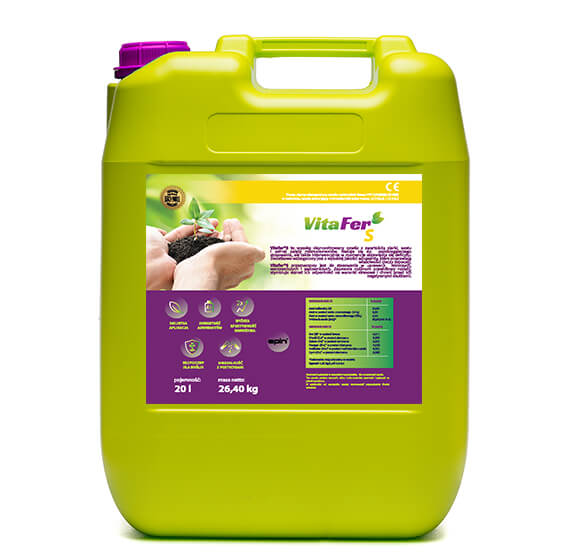
Description
Recommendations for use:
– for the preventive and intervention supply of the nutrient to crops to prevent sulphur deficiency.
– to improve the uptake of nitrogen from the soil by stimulating root system development and increasing nutrient uptake.
– to increase plant resistance and protect against the negative effects of abiotic and biotic stresses.
– to increase yield quantity and quality
– to improve the frost resistance of plants
| MACROELEMENTS | % weight | % volume |
|---|---|---|
| Nitrogen (N) | 15.00 | 19.80 |
| Sulfur (SO3) | 52.50 | 69.30 |
| MICROELEMENTS | % weight | % volume |
| Boron (B) | 0.011 | 0.014 |
| Copper (Cu) | 0.005 | 0.006 |
| Iron (Fe) | 0.021 | 0.027 |
| Manganese (Mn) | 0.013 | 0.017 |
| Molybdenum (Mo) | 0.001 | 0.0013 |
| Zinc (Zn) | 0.005 | 0.006 |
The role of sulphur in crops:
- favourably influences protein and fat synthesis in the plant
- enhances photosynthesis
- increases the dry matter of the plant
- increases nitrogen productivity, resulting in better plant growth
- increases the plant’s resistance to abiotic stresses (low and high temperatures, water shortage)
- increases the plant’s resistance to biotic stresses – helps control fungal diseases, especially powdery mildew.
Sulphur deficiencies result in:
- In acute deficiency, there are characteristic symptoms of sulphur deficiency and consequent reduction in yield and quality. Symptoms are observed on the youngest leaves.
- Reduced photosynthetic activity
- Stunted growth, small leaves, spoon-shaped leaves
- Inhibition of protein and chlorophyll synthesis
- Reduction in the size of the flowers, their falling off shortly after the start of flowering
- Reduction in the size of the silique and the number of grains in the silique
- Poor growth of young roots
Dosage and timing of application:
| Crop | Dose (l/ha) | Number of Treatments and Application Timing |
|---|---|---|
| Sugar Beet | 3 – 5 | 2 treatments: from the 4 – 6 leaf stage to 100% canopy closure (BBCH 16-39) |
| Onion, Garlic, Leek, Chives | 3 – 5 | 2 treatments: at intensive vegetation stage, at an interval of 14 days |
| Fruit Trees and Shrubs | 4 – 5 | 3 treatments: from green bud stage (BBCH 51-59) |
| Cabbage, Cauliflower, Broccoli, Brussels Sprouts, Chinese Cabbage | 3 – 5 | 2 treatments: at intensive vegetation stage, at an interval of 14 days |
| Maize | 3 – 5 | 1 treatment: at 4 – 8 leaf stage (BBCH 14-18) |
| Oilseed Rape | 3 – 5 | 2 treatments: in autumn one treatment from the 4-8 leaf stage (BBCH 16-25), in spring one treatment from the beginning of main shoot elongation just after winter rest (BBCH 30-40) |
| Cereals (Especially Winter Wheat and Barley) | 4 – 5 | 2 treatments: in autumn one treatment from the 3 leaf stage (BBCH 13-25), in spring one treatment after winter rest until the beginning of earing (BBCH 31-50) |